AI Launch Emails Made Easy: A 7-Email Checklist

Inbox Magic: AI-Assisted Launch Emails That Sound Like You (Without the Stress)
Launching a new digital product or running a limited-time promotion can turn email into the biggest bottleneck: too many messages, too little time, and a constant worry that the copy won’t land. A simple AI-assisted checklist keeps the sequence organized, consistent, and on-brand—so every email has a clear purpose, a clear offer, and a clear next step.
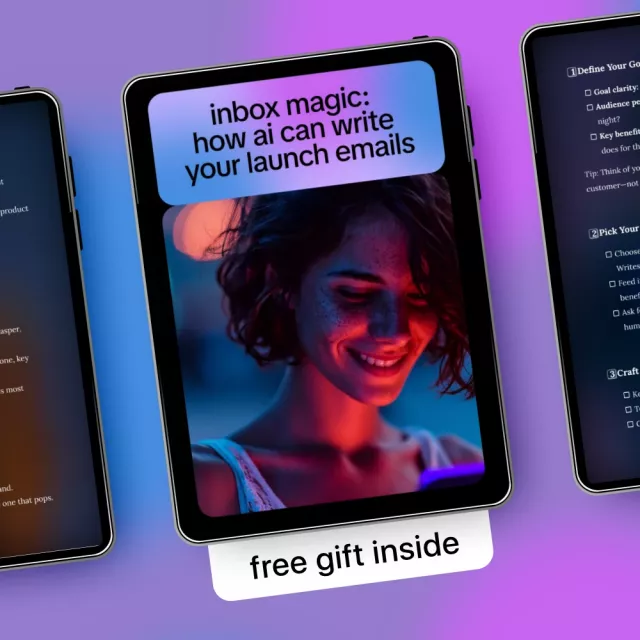
If you want a ready-to-use, copy-friendly framework, the downloadable guide Inbox Magic: How AI Can Write Your Launch Emails – Simple Checklist Guide for Digital Creators & Online Stores is built around the same practical approach: prep the right inputs, generate fast drafts, then add the human details that make emails feel personal.
What makes launch emails work (even with a small list)
Launch emails don’t need a giant list to work—they need clarity and consistency. The best-performing sequences tend to share a few traits:
- A single, specific promise: one clear transformation the offer delivers and who it’s for.
- A consistent thread across the sequence: the same core idea expressed through different angles (story, proof, behind-the-scenes, objections).
- One primary action per email: read, click, reply, watch, or buy—no competing calls to action.
- A cadence that builds momentum: warm-up, open cart, mid-launch proof, final-day urgency.
- Message match: subject line, first paragraph, and call-to-action all align with the same outcome.
Benchmarks vary widely by industry and list quality, but it helps to keep realistic expectations and track your own baselines over time. For a reference point, Mailchimp’s published email marketing benchmarks can provide helpful context for typical opens and clicks: Mailchimp — Email marketing benchmarks and statistics.
The simple checklist before AI writes a single line
AI gets dramatically better when it’s working from tight, copy-ready notes rather than a vague description of your offer. Before you generate any draft, collect these inputs:
- Offer snapshot: name, price, start/end date, bonuses, guarantee, and the one-liner promise.
- Audience snapshot: who it’s for, who it’s not for, and the top three pain points it solves.
- Voice rules: 3–5 “always do” traits (warm, direct, punchy, playful) and 3 “never do” traits (overhype, guilt, jargon).
- Proof assets: testimonials, screenshots, results, case studies, or a personal story that demonstrates credibility.
- Objection list: time, money, complexity, “will this work for me?”, alternatives, and prior bad experiences.
- Friction removers: FAQ, setup steps, what happens after purchase, and support details.
- Links & tracking: sales page URL, checkout URL, UTM parameters, and a single button/link style for consistency.
Pre-Launch Inputs (Copy-Ready Notes)
| Checklist item | What to prepare | Example |
|---|---|---|
| One-sentence promise | Outcome + timeframe or mechanism | “Turn old posts into a 5-email launch in one weekend.” |
| Ideal reader | Role + situation + goal | “Digital creators selling templates who want reliable launches.” |
| Top 3 objections | Why someone hesitates | “Too busy”, “Email feels salesy”, “My list is small” |
| Proof | 2–4 pieces of credibility | “Before/after metrics, testimonial quote, mini case study” |
| CTA destination | One primary link per email | “Checkout page with UTM source=email” |
A practical AI workflow: from messy notes to ready-to-send emails
The fastest path to “sounds like you” isn’t generating more words—it’s generating the right structure, then tightening with specifics.
One practical tip: test how your emails render across major clients, because formatting can shift dramatically. Litmus regularly reports email client usage trends that can guide your testing priorities: Litmus — Email client market share.
Launch sequence blueprint (with timing and purpose)
7-Email Launch Schedule (Adapt as Needed)
| Day | Purpose | Primary CTA | |
|---|---|---|---|
| -3 | Warm-up: the “why” | Reconnect and prime interest | Reply with a quick question |
| -2 | Quick win lesson | Build trust with a small result | Click to read/watch |
| 0 | Cart open | Make the offer and explain value | Buy now |
| +2 | Proof | Reduce risk with social proof | See what’s included |
| +4 | Objection-buster | Handle the #1 concern | Buy now |
| +6 | FAQ | Clarify details and remove friction | View FAQ / Buy |
| +7 | Final day | Honest urgency and recap | Last chance to buy |
Subject lines, openings, and calls-to-action that stay true to your voice
If you’re promoting an affiliate offer or paid partnership, keep disclosures clear and easy to notice. For practical guidance on truthful marketing practices, see: FTC — Advertising and Marketing on the Internet: Rules of the Road.
Common mistakes AI makes (and how to fix them fast)
A lightweight review checklist before sending
Shop quick picks (digital guides)
- Inbox Magic: How AI Can Write Your Launch Emails – Simple Checklist Guide for Digital Creators & Online Stores — a compact checklist-and-template style resource for building a clean launch sequence fast.
- How to Value Your Car Like a Pro Before Selling or Trading – Ultimate Guide to Car Valuation for Sale or Trade-In — a step-by-step digital guide for pricing decisions when selling or trading a vehicle.
FAQ
Can AI write my entire launch email sequence without editing?
AI can draft a full sequence quickly, but the best results come from adding specifics (proof, real deliverables, boundaries, and accurate details) and doing a final voice-and-accuracy pass before sending.
How many launch emails are enough for a digital product?
Most launches work well with 5–9 emails, depending on how warm your list is and how long the cart is open. A 7-email structure is a reliable starting point, then adjust cadence based on engagement and time window.
Will AI-written emails hurt deliverability?
Deliverability depends more on list health, authentication, formatting, and avoiding deceptive or spammy language than on whether AI helped draft the text. Keep one clear CTA, test across inboxes, and use honest subject lines and claims.














Leave a comment